Kis türelmet...

Kis türelmet...



8 hónapja | 0 hozzászólás
1. Introduction
In modern continuous casting and secondary steelmaking operations, maintaining steel cleanliness between the ladle and tundish is of critical importance. One of the most essential refractory components serving this function is the Submerged Entry Shroud (SES), also referred to as the sub entry shroud or ladle-to-tundish shroud. The SES provides a protected flow channel for molten steel, preventing reoxidation, minimizing inclusion formation, and stabilizing steel flow.
Although the submerged entry shroud is often considered a “passive” refractory component compared with the submerged entry nozzle (SEN), recent experimental and industrial studies—particularly those focusing on decarburization, oxidation, and clogging mechanisms—have demonstrated that the internal condition of the shroud plays a decisive role in downstream steel quality and nozzle performance.
8 hónapja | 0 hozzászólás
1. Introduction
In continuous casting of steel, controlling the transfer of molten steel from the tundish to the mold is one of the most critical tasks for ensuring product quality, process stability, and operational safety. Among the refractory flow-control and protection devices used in this zone, the Sub Entry Shroud (SES) plays a decisive role. The sub entry shroud is not merely a mechanical connection between the tundish nozzle and the mold; it is a key metallurgical component that protects molten steel from reoxidation, stabilizes flow, and directly influences inclusion behavior and surface quality of the cast strand.
8 hónapja | 0 hozzászólás
1. Introduction
In modern steelmaking, continuous casting has become the dominant technology for transforming molten steel into semi-finished products such as slabs, blooms, and billets. Within this process, the tundish plays a critical role as an intermediate vessel between the ladle and the mold. Beyond its function as a distributor of liquid steel, the tundish is also a metallurgical reactor where temperature control, inclusion flotation, and flow optimization occur. One of the most important flow-control devices installed in the tundish is the tundish stopper rod.
8 hónapja | 0 hozzászólás
1. Bevezetés
A Sub-Entry Shroud (SES) – más néven acélbevezető védőcső – kulcsfontosságú tűzálló elem a folyamatos acélöntési technológiában. Ez a cső köti össze az acélüst kifolyó fúvókáját a közbenső üst (tundish) bemeneti rendszerével, illetve egyes konfigurációkban a merülő belépő fúvókával (SEN).
A SES elsődleges feladata az, hogy megvédje az olvadt acélt a levegővel való érintkezéstől, megakadályozza a másodlagos oxidációt, csökkentse a nitrogénfelvételt, valamint stabilizálja a fémáramlást.
1. Introduction
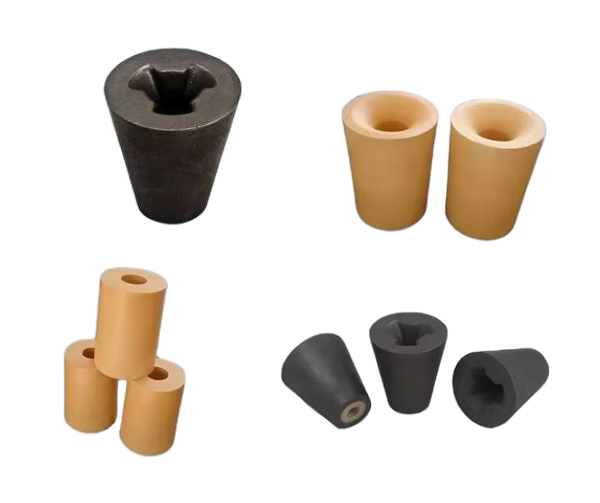
Thetundish metering nozzle is a critical refractory component in continuous casting, serving as the final flow-control element between the tundish and the mold or submerged entry nozzle. Its performance directly influences casting stability, steel cleanliness, surface quality, productivity, and operational safety. Despite continuous improvements in refractory materials and casting technology, tundish metering nozzles remain vulnerable to a range of operational, metallurgical, thermal, and mechanical problems.
1. Introduction
The monoblock stopper rod is a critical flow-control refractory component used in modern continuous casting operations. Installed in the tundish, it regulates molten steel flow into the submerged entry nozzle (SEN) by precise vertical movement. Compared with traditional multi-piece stopper systems, monoblock stopper rods offer advantages such as improved structural integrity, better sealing performance, and more stable casting control.
 tundish Stopper
However, cracking of monoblock stopper rods remains one of the most common and serious operational problems.
1. Introduction
The monoblock stopper rod is a critical flow-control refractory component used in modern continuous casting operations. Installed in the tundish, it regulates molten steel flow into the submerged entry nozzle (SEN) by precise vertical movement. Compared with traditional multi-piece stopper systems, monoblock stopper rods offer advantages such as improved structural integrity, better sealing performance, and more stable casting control.
tundish Stopper
However, cracking of monoblock stopper rods remains one of the most common and serious operational problems.
10 hónapja | 0 hozzászólás
1. Introduction
In modern continuous casting operations, the tundish nozzle plays a crucial role in regulating molten steel flow from the tundish into the Submerged Entry Nozzle (SEN) or directly into the mold. Its reliability and flow-control stability directly impact mold level fluctuation, inclusion removal, casting speed, steel cleanliness, and overall process efficiency. Among various nozzle types, the isostatic tundish nozzle—also known as the isostatically pressed tundish nozzle—has emerged as a high-performance solution due to its superior density, strength, and anti-erosion characteristics.
During the continuous casting operation of the continuous casting machine, the stable use of the ladle long nozzle, the tundish stopper rod and the immersed nozzle is the key to achieving high-reliability continuous casting. The use of the tundish stopper rod mainly causes the adhesion of inclusions and the erosion of the stopper rod head. The slag-making process optimization and calcium treatment can effectively solve the problem of inclusion adhesion. Therefore, the stopper rod erosion problem has become the key to affecting the stable continuous casting operation.
E-mail: ugyfelszolgalat@network.hu

Wear Mechanisms and Wear Reasons of Slide Gate Plates in Steelmaking Operations
8 hónapja | 0 hozzászólás
In secondary metallurgy and continuous casting, the slide gate system is an indispensable flow-control component that ensures stable, adjustable, and safe discharge of molten steel from the ladle or tundish. At the heart of this system lie the slide gate plates—high-performance refractory components engineered to withstand extreme thermal, mechanical, and chemical stresses. Their wear behavior directly affects casting stability, steel cleanliness, ladle lining life, and operational safety. Understanding the fundamental wear mechanisms of slide gate plates is therefore essential for metallurgists, refractory engineers, and plant operators aiming to optimize performance and minimize casting disturbances.
Címkék: slide gate plate sliding plate
Tovább